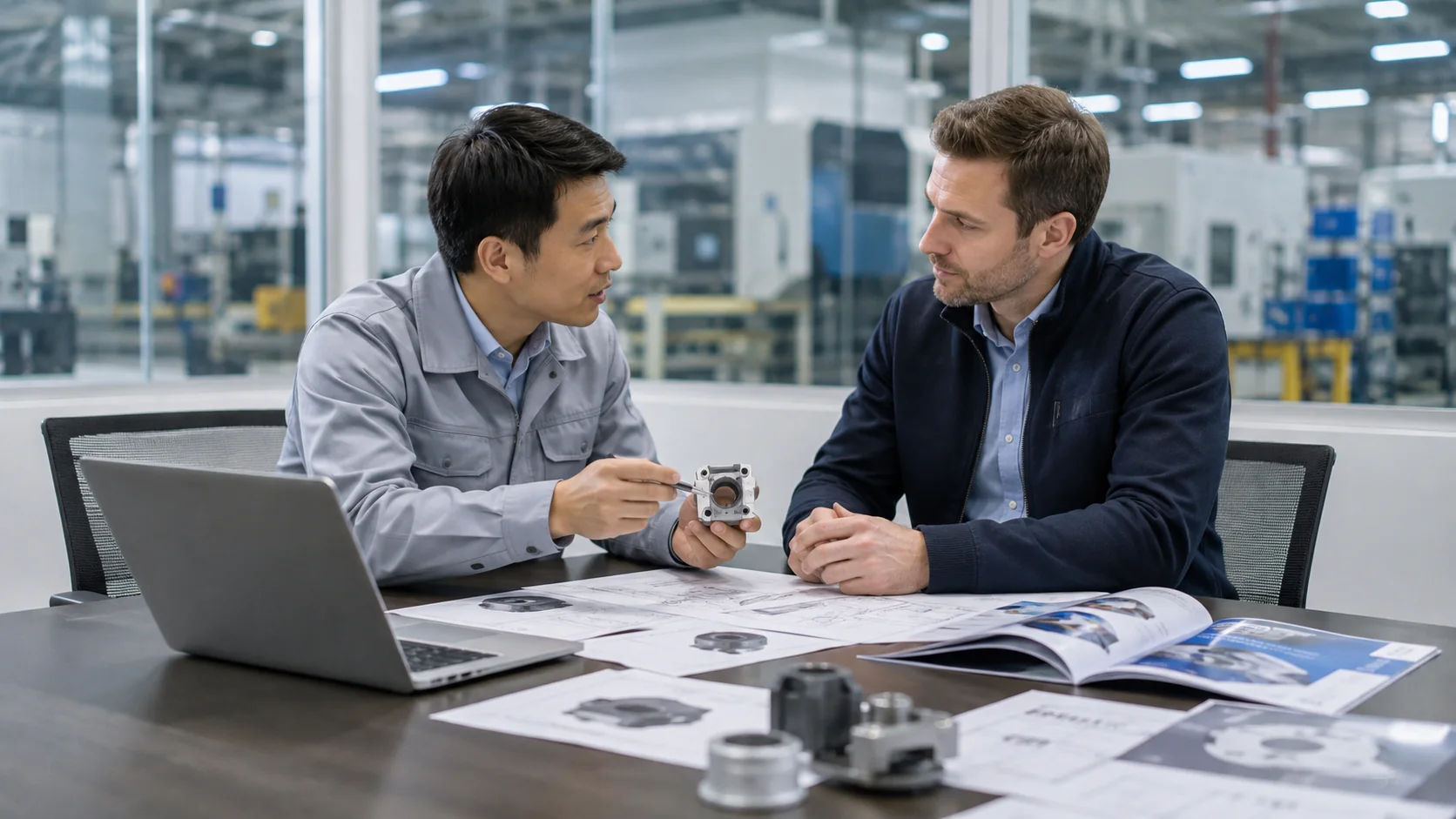
A factory visit is more than a walk through production
A good factory visit is not simply a walk through a production hall.
You may spend time with the sales team, engineers, production managers and quality staff. You may review drawings in a meeting room, walk through several production processes, look at raw materials and finished goods, ask how certain operations are controlled, and return to the meeting room with a completely new set of questions.
Sometimes what you see confirms what the supplier has already told you. Sometimes it raises new questions. Both outcomes are valuable.
If you are still preparing for your trip, the broader planning guide covers what to do before arriving at the factory. This article focuses on something different: what actually happens once you get there.
1. Arrival and introductions
Most factory visits begin more quietly than first-time buyers expect.
After arriving, you will normally be welcomed by your existing sales contact or another member of the supplier's team. Depending on the size of the company and importance of the project, an engineer, sales manager, production manager or company owner may also join.
There may be tea, business cards and a few minutes of general conversation before the formal discussion starts. Do not dismiss this part as wasted time. It gives you an early opportunity to understand who is actually involved in your project.
For example:
- Is your sales contact able to answer technical questions?
- Has an engineer been assigned to your project?
- Who makes decisions on pricing or customization?
- Does the production manager understand the product being discussed?
- Who will be responsible after an order is placed?
One practical point is to ask everyone to briefly explain their role. It can save a surprising amount of confusion later.
2. The supplier presentation
Many Chinese suppliers will begin the formal part of the visit with a company introduction.
This may include:
- company history
- main products
- factory size
- export markets
- major equipment
- production capacity
- certifications
- customers or industries served
- quality-control procedures
The presentation is useful, but it should be treated as the starting point of the discussion, not the conclusion. Listen for things that you can later verify during the factory tour.
For example, if a supplier says a certain production process is performed in-house, look for that process when you walk through the factory. If they describe a large engineering department, you may want to meet the engineers who would actually support your project.
A productive China factory visit connects what you hear in the meeting room with what you later observe on the production floor.
3. Discussing your product or project before the tour
Before walking through the factory, it is often useful to discuss your own requirements.
For an off-the-shelf product, the conversation may focus on:
- specifications
- quantities
- packaging
- lead time
- MOQ
- quality requirements
For customized products, components or machinery, the discussion can become much more technical. You may be reviewing:
- CAD drawings
- dimensions
- materials
- tolerances
- production speeds
- electrical standards
- testing requirements
- samples
- drawings from previous quotations
- requested modifications
This is also where communication quality starts to matter. A supplier may speak good conversational English but still struggle with specialized technical terminology. Conversely, an engineer may understand your requirement very well but not be comfortable explaining it in English.
For meetings involving detailed technical or commercial discussions, professional interpretation can help both sides clarify what is actually being agreed rather than simply translating individual words.
4. Walking onto the production floor
For many overseas buyers, this is the most important part of the visit. The production tour allows you to move from presentations and promises to actual manufacturing conditions.
Instead of only looking at how clean or impressive the factory appears, pay attention to how production actually flows. You may see:
- raw material preparation
- machining
- assembly
- converting
- welding
- electronics assembly
- packaging
- testing
- semi-finished products
- finished-goods storage
The exact process obviously depends on the industry. What matters is understanding which activities happen inside this factory and which ones happen somewhere else.
One simple question is surprisingly useful: "Which processes are done here, and which processes are outsourced?"
Outsourcing is not automatically a problem. Many capable manufacturers use specialized subcontractors. What matters is understanding the real production chain rather than assuming everything shown in a quotation is produced under one roof.
5. Looking at machines is not enough
A common mistake during a first factory tour in China is spending too much time photographing machines and too little time asking how they are actually used.
The presence of expensive equipment does not automatically tell you:
- how often it runs
- who operates it
- what products it is used for
- whether it is a bottleneck
- how maintenance is managed
- whether the supplier has enough capacity for your order
Watch the production flow. Are machines actually running? Are workers producing products similar to what you intend to buy? Are there large amounts of work-in-process material between operations? Are some processes much more manual than you expected?
These observations often lead to more useful conversations than simply asking, "What is your annual capacity?" Capacity figures can be difficult to interpret without knowing assumptions such as shifts, product mix, changeover time and current utilization.
6. Understanding quality control
Quality control is another area where an on-site visit can provide much more context than a certificate or company presentation.
Depending on the type of factory, you may see:
- incoming material inspection
- in-process inspection
- measuring equipment
- testing stations
- final inspection
- sample retention
- quality records
- non-conforming product areas
- finished product testing
You do not need to turn every supplier visit into a formal audit. Instead, try to understand the supplier's actual quality process.
Useful questions include:
- What is checked when materials arrive?
- Which production stages require inspection?
- What happens when a defect is found?
- Who decides whether a product passes?
- What records are kept?
- How are customer-specific requirements controlled?
If your purpose goes beyond a general visit and you need a broader understanding of the supplier's background, manufacturing capability and potential risks, buyer-side evaluation support is designed around that wider question.
7. Visiting the warehouse
The warehouse is easy to skip, but it can be one of the more revealing parts of a factory visit.
Depending on the company, you may be able to see:
- incoming raw materials
- components
- work-in-progress
- packaging materials
- finished products
You are not simply looking for a perfectly tidy warehouse. Instead, observe how materials are identified and organized.
You might ask:
- How are incoming materials identified?
- Are materials traceable to different suppliers or batches?
- How are finished orders separated?
- Which important components are kept in stock?
- Which materials have long purchasing lead times?
For machinery or customized products, long-lead components can have a significant impact on the real delivery schedule.
8. Meeting the engineers
If your product has technical requirements, try not to conduct the entire visit only through the supplier's sales department. Meeting an engineer can change the quality of the conversation very quickly.
This is particularly important for:
- custom machinery
- automation
- industrial components
- electronics
- tooling
- private-label products requiring modification
An engineer may be able to explain why a requirement is difficult, suggest an alternative design or identify a detail that has not been considered in the quotation.
Pay attention not only to whether the engineer agrees with you, but whether they ask good questions. Sometimes a supplier that asks difficult technical questions is more reassuring than one that immediately replies, "No problem. We can do everything." Real manufacturing projects usually involve trade-offs.
9. Asking questions during the tour
Do not save every question until you return to the meeting room. Some of the best questions arise from what is directly in front of you.
For example:
- Is this product made for export?
- Is this the same model you quoted to us?
- How long does this process take?
- Is this component manufactured here?
- What happens after this step?
- How is this dimension checked?
- What causes most defects at this stage?
- How long does changeover take?
These questions often lead to practical discussions that would never have appeared on a prepared presentation. If you want a more structured list before your visit, the following guide can help.
10. Returning to the meeting room
A good factory tour usually creates more questions than it answers. That is normal. Once the tour is finished, return to the meeting room and review what you observed while the details are still fresh.
For example:
- Did the factory have the equipment you expected?
- Which processes are outsourced?
- Did you identify any capacity limitations?
- Is a technical change required?
- Does the quotation need updating?
- Do you need additional certificates or documents?
- Does the supplier need to produce a new sample?
- Are there quality points that require clarification?
Do not leave these conversations entirely to email after returning home if they can be clarified immediately.
11. Commercial discussions usually come later
Pricing is obviously important, but a factory visit is usually more useful if you understand the production situation before negotiating the final commercial points.
Once technical requirements are clearer, you may discuss:
- price
- MOQ
- tooling cost
- payment terms
- delivery schedule
- samples
- warranty
- spare parts
- packaging
- Incoterms
- installation or after-sales service
One reason factory visits can improve negotiations is that both sides are now discussing the same physical process rather than relying only on emails. If you saw that a requested customization requires an additional process, for example, you have better context for understanding its effect on price and delivery time.
12. Agree on next steps before you leave
One of the simplest improvements you can make to a supplier visit is to spend the last 10–15 minutes defining what happens next. Do not finish with, "We will keep in touch." Instead, agree on specific actions.
For example:
- Supplier: send revised quotation by Friday, confirm motor specification, provide updated drawing and prepare sample.
- Buyer: confirm annual quantity, approve packaging layout and provide technical standard.
- Both sides: hold a follow-up video meeting next Tuesday.
Write these actions down. A productive visit is not measured by how many factory photos you take. It is measured by how much uncertainty has been removed from the project.
13. What can you really learn by visiting Chinese factories?
Visiting a factory does not magically prove that a supplier will perform perfectly in the future. But it can give overseas buyers a much clearer understanding of:
- real manufacturing capability
- production processes
- equipment
- engineering resources
- quality-control practices
- outsourcing
- communication quality
- management involvement
- capacity constraints
- potential areas requiring further verification
It is also much easier to judge whether the supplier's online presentation is broadly consistent with what you see in person. That is one reason visiting Chinese factories remains valuable even when sourcing platforms, video calls and online supplier research have become much better.
14. What if you are visiting several factories?
This is where the logistics can become surprisingly difficult. A map may show two suppliers in the same province, yet driving between their factories could still take several hours. Industrial factories are also often located outside city centers.
A realistic itinerary needs to consider:
- actual factory location
- traffic
- high-speed rail schedules
- travel to and from railway stations
- meeting overruns
- hotel location
- supplier availability
- meal breaks
- interpreter availability
Trying to visit three distant factories in one day often results in rushed meetings and missed details. If your trip includes several suppliers or multiple cities, coordinated business support can help arrange factory appointments, transportation, interpreter requirements and the overall visit sequence.
15. Visiting factories after the Canton Fair
Some buyers organize factory visits around the Canton Fair. This can work very well. You may first meet a number of potential suppliers at the exhibition, narrow them down to a shortlist, and then spend several additional days visiting the most promising factories.
But do not assume every supplier can receive you immediately after the fair. Factory schedules, travel distances and appointment availability should be discussed in advance.
If Guangzhou is part of your trip, the YunBridge fair guide covers registration, travel planning, supplier appointments, interpreter preparation and combining exhibition attendance with supplier visits.
Canton Fair guide for overseas buyers ->
This creates a practical sequence: Canton Fair → Supplier Shortlist → Factory Visit → Evaluation → Follow-Up.
16. Do you need a factory visit agent?
Not every buyer does. If you already know the supplier well, speak Chinese, understand the manufacturing process and only need a simple factory tour, you may be perfectly comfortable organizing the visit yourself.
Broader support becomes more useful when:
- you are visiting China for the first time
- you have several factories to visit
- suppliers are located in different cities
- technical interpretation is required
- you need help preparing questions
- you want to evaluate more than the showroom
- supplier coordination is becoming time-consuming
- you need someone to follow unresolved issues after the visit
For buyers who want support before, during and after the visit, the service can cover supplier scheduling, trip coordination, interpreter support, on-site communication and follow-up.
17. A factory visit is more than a factory tour
People sometimes search for "factory tour China" expecting the visit to be mainly a guided walk through a production facility. For serious procurement projects, that is only one part of it.
The real value comes from combining what the supplier tells you with what you see, and then asking the right follow-up questions.
A useful China factory visit might reveal that the supplier is stronger than expected. It might also reveal weaknesses that were impossible to identify from quotations and video calls. Either way, you leave China with better information. And that is the real purpose of the visit.
Before arranging the visit, read whether a supplier factory visit is worth it before a large order to decide whether the information you need justifies the travel and coordination effort.