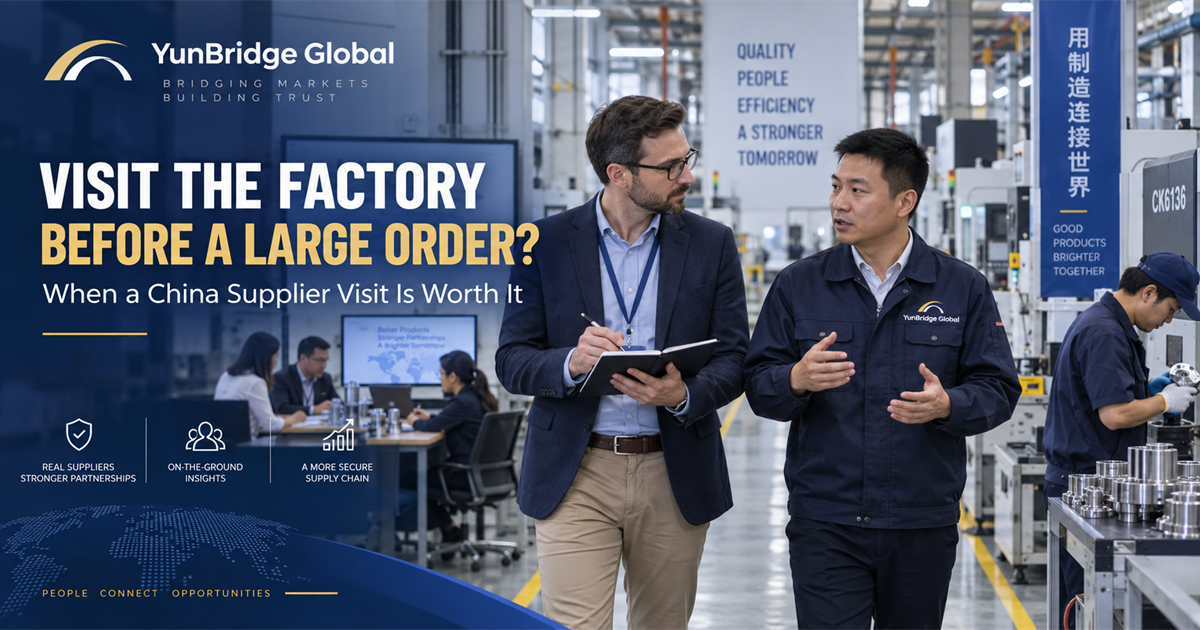
When a Factory Visit Is Usually Worth It
The case for visiting becomes stronger when the downside of a poor supplier decision is difficult to reverse. This can include a large order value, a significant deposit or advance payment, a new supplier relationship, a customized product, industrial machinery, production equipment, tooling investment, technical drawings, tight tolerances, engineering changes or safety- and quality-sensitive requirements.
- The supplier is new and has not yet demonstrated consistent production.
- The product is customized, technically complex or difficult to transfer to another supplier.
- Tooling, molds, engineering work or other up-front investment is required.
- The order will support a long-term supply relationship.
- Several suppliers look similar on paper and need a closer comparison.
- The supplier makes claims about capability, capacity or in-house processes that are difficult to verify remotely.
- A delivery failure would materially affect your launch, customer commitments or business operations.
A visit is especially useful when it can answer a specific unresolved question. The goal is not to tour a factory because travel is available; it is to collect evidence that changes a purchasing decision.
When You May Not Need to Visit
Not visiting does not mean doing no verification. A physical visit may be unnecessary when the order is a small test order, the product is a standard catalog item, commercial exposure is low, specifications are simple, or the supplier relationship has a strong history of acceptable performance.
- The supplier has already been independently checked and has relevant production history.
- The buyer has an approved sample, clear specifications and a documented production process.
- A reliable third-party inspection or testing arrangement is available.
- The cost of switching suppliers is low if the order does not perform as expected.
- Live video, documents, references and prior orders already resolve the main uncertainties.
Remote verification can sometimes be enough, but it should be a deliberate decision based on evidence. A video call controlled by the supplier, for example, may not answer the same questions as an on-site observation or independent inspection.
Factory Visit Decision Matrix
| Situation | Factory Visit Priority | Why |
|---|---|---|
| Small standard order | Low | Commercial exposure and technical uncertainty are limited. |
| First order with a new supplier | Medium–High | Supplier capability and communication have not yet been proven. |
| Large deposit required | High | More capital is exposed before delivery. |
| Customized industrial machinery | Very High | Engineering, assembly, testing and after-sales capability are difficult to assess remotely. |
| Significant tooling investment | High | Changing suppliers later can be costly. |
| Existing proven supplier | Low–Medium | Prior performance may reduce uncertainty. |
| Multiple suppliers under final comparison | High | An on-site comparison can reveal differences hidden in quotations. |
| Tight technical tolerances | High | Process control and engineering capability matter. |
| Simple repeat order | Low–Medium | Existing specifications and performance history may be sufficient. |
These priority levels are a practical framework, not a scientifically validated rule. The right decision still depends on the product, supplier evidence, commercial exposure and what the buyer needs to learn.
What Can You Learn at the Factory That Is Difficult to Verify Online?
Actual Manufacturing Capability
A visit can help buyers compare the supplier's claimed processes and equipment with the relevant production environment. Seeing appropriate machinery, assembly areas, testing points and finished or current work may answer questions that a website or quotation cannot.
In-House vs Outsourced Processes
The supplier may perform some operations internally and subcontract others. That is not automatically a problem, but the buyer should understand which processes are controlled by the quoted company and who is responsible for quality and delivery. The guide on
whether a Chinese supplier is a manufacturer or trading company explains why this distinction matters.
Production Capacity and Bottlenecks
Relevant equipment, production lines or stations, workflow, current workload, staffing, shifts and bottlenecks can be discussed more concretely on site. One visit cannot fully prove future capacity, but it can expose questions about whether the proposed schedule and order volume fit the supplier's actual setup.
Quality-Control Reality
There is a difference between a supplier saying it has quality control and observing inspection processes, test equipment, defect handling and quality documentation. A factory visit does not replace product inspection, but it can help a buyer understand how quality is managed before the goods reach final inspection.
For the wider prevention, verification and corrective-action process, see Quality Control When Sourcing from China.
Engineering and Technical Access
Industrial machinery, automation, custom products and technical components often require access to engineering and production staff. A visit can show whether the people discussing the drawings and tolerances are actually available to support the project, rather than leaving all technical questions with a sales contact.
The People Responsible for Your Order
A large project may involve sales, a project manager, engineering, quality, production and management. Understanding who owns decisions, who receives technical changes and who handles problems can matter as much as the physical factory.
What a Factory Visit Cannot Guarantee
A factory visit is evidence from a particular time and place. It cannot guarantee zero defects, future on-time delivery, no later subcontracting, no management changes, no future quality problems, no commercial disputes, no capacity constraints or perfect communication.
A factory visit reduces uncertainty; it does not eliminate risk.
The value of the visit is better information for a commercial decision. Buyers may still need samples, written specifications, production follow-up, product inspection, testing, contract review or specialist advice depending on the order.
Cost of Visiting vs Cost of Choosing the Wrong Supplier
A visit has visible costs: flights, hotels, local transport, time, interpreter or local coordination and the opportunity cost of being away from other work. These costs should be compared with the potential downside of choosing the wrong supplier.
- Deposit exposure or other advance commitments.
- Defective goods, rework or replacement production.
- Missed delivery dates or a delayed product launch.
- Lost tooling, engineering redesign or the cost of transferring the project.
- Customer complaints and the time required to find a replacement supplier.
If the commercial downside of supplier failure is significantly greater than the cost and effort of visiting, an on-site visit becomes easier to justify. This is a risk-based decision, not a rule that every overseas buyer must travel to China.
Factory Visit vs Remote Verification vs Third-Party Inspection
| Method | Best For | Limitations |
|---|---|---|
| Video call | Initial visual verification | The supplier controls what is shown. |
| Samples | Product evaluation | Samples do not prove production capability or future consistency. |
| Supplier background research | Legal and company verification | Documents do not fully verify physical manufacturing capability. |
| Factory visit | Capability, people, production environment and process understanding | A visit is a snapshot in time, not a guarantee. |
| Third-party inspection | Checking goods against defined criteria | Usually focused on the product or order, not the full supplier relationship. |
| Laboratory testing | Technical, safety or regulatory testing | Testing does not evaluate overall supplier management or organization. |
Factory visit is not the same as product inspection or laboratory testing. A buyer may need more than one method when the product is technically complex, safety-sensitive, regulated or difficult to replace.
A China Supplier Evaluation can help organize supplier evidence before deciding whether an on-site visit or specialist inspection is appropriate.
What Should You Check If You Decide to Visit?
Keep the visit focused on the questions that could change your decision: legal and company identity, relevant production processes, key equipment, capacity, engineering capability, quality-control process, warehouse and material flow, outsourced processes, current production, project-specific requirements and the team members responsible for the order.
Do not treat a busy showroom or a polished presentation as proof of every capability. Connect what you observe with the product, process and delivery requirements in your project.
If the supplier is proposing a pick-and-place automation system, use the pick-and-place robot manufacturer checklist to define the technical questions and test evidence for the visit.
For the practical on-site details, use the Factory Visit Checklist for Overseas Buyers in China and 25 Questions to Ask During a China Factory Visit rather than trying to reproduce those full guides here.
A Practical Decision Rule Before a Large Order
The case for an on-site factory visit becomes stronger as more of these conditions apply:
- The supplier is new.
- The order value or deposit exposure is significant.
- The product is customized.
- Tooling or engineering work is required.
- Manufacturing capability is difficult to verify remotely.
- Delivery failure would materially affect the business.
- Quality requirements are demanding.
- Long-term cooperation is expected.
- Several suppliers appear similar on paper.
The more of these conditions apply, the stronger the case for an on-site visit. There is no universal condition count that makes a visit mandatory; the decision remains a comparison between risk, evidence and verification cost.
When Remote Verification May Be Enough
A physical visit may be unnecessary when the buyer already has sufficient confidence from several independent sources: verified company information, a live video walkthrough, technical discussions, representative samples, approved specifications, a documented production process, prior order history, third-party inspection, trusted references or independent testing where appropriate.
Remote verification is not risk-free. It is a reasonable option when the product is relatively straightforward, the supplier has a credible history and the remaining uncertainty is proportionate to the order exposure. If important questions remain unanswered, a visit or specialist review may still be justified.
Buyers who need to assess a supplier before arranging travel can start with how to evaluate a Chinese supplier before a factory visit.
When Local China-Side Support Can Help
Local support can be useful when a buyer cannot travel personally, several factories must be compared, meetings require Chinese-English communication, technical discussions need coordination, schedules between factories are complex, transportation between sites needs planning, visit observations need structured follow-up or unresolved issues must be tracked after the visit.
YunBridge supports overseas buyers with China-side factory visit planning, supplier meeting coordination, Chinese-English communication, supplier evaluation and post-visit follow-up. For factory visit support in China, the appropriate scope depends on the supplier, product, travel plan and project questions.
If several suppliers are still being compared, broader China sourcing support may be more appropriate than arranging a visit to only one company.
Conclusion
A factory visit is not necessary for every order. Before a large, customized or strategically important purchase, however, visiting the supplier can be worthwhile when it reduces uncertainties that cannot be resolved remotely.
The useful question is not whether every buyer should visit every factory. It is whether the risk of choosing the wrong supplier is greater than the cost and effort of verifying the supplier on site.