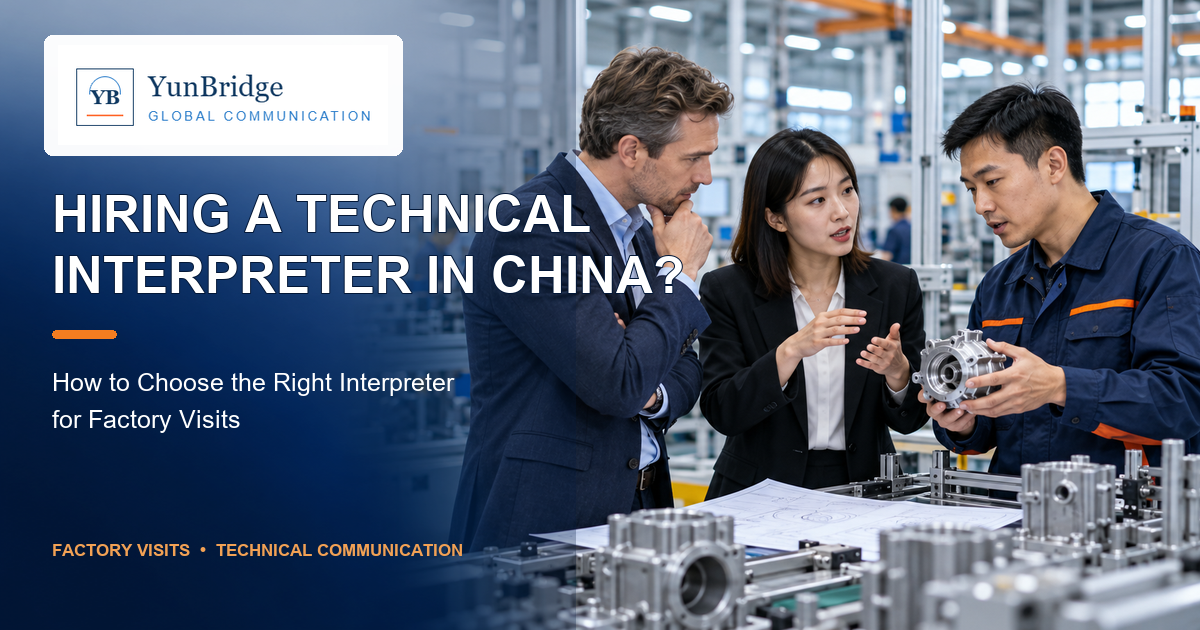
1. Why Hiring a Technical Interpreter Is Different From Hiring a General Interpreter
Imagine an overseas buyer visiting several arcade machine manufacturers in China.
The visit lasts five days. Meetings involve electronics, mechanical assembly, quality-control procedures, production capacity, component sourcing, and delivery schedules.
The buyer needs someone who can interpret between English and Mandarin during supplier presentations, factory tours, technical questions, and commercial discussions.
In an August 2026 Reddit discussion about hiring a five-day factory interpreter, a buyer described essentially this requirement.
The public replies were mostly offers of availability or requests to continue the conversation privately. They provided little practical guidance on testing technical interpreting skills.
That highlights an important problem.
How can a buyer tell whether an interpreter is actually qualified for manufacturing discussions before the factory visit begins?
A candidate may communicate comfortably in everyday English but struggle when engineers discuss:
- Electrical wiring and printed circuit boards.
- Mechanical assembly tolerances.
- Product inspection and testing.
- Production bottlenecks.
- Manufacturing capacity versus actual output.
- Defect rates and corrective actions.
- Component procurement.
- Lead times and delivery commitments.
These discussions require linguistic accuracy and enough subject-matter familiarity to recognize when a technical expression needs clarification.
An interpreter does not need to be an engineer. But they must understand their professional limits, prepare appropriately, and avoid guessing at unfamiliar terminology.
2. What Does a Technical Interpreter Actually Do During a Factory Visit?
A technical interpreter facilitates spoken communication between people discussing specialized subjects.
For a manufacturing visit, that can involve interpreting between overseas buyers and Chinese salespeople, engineers, production managers, quality personnel, and business owners.
Consecutive interpreting
For many small supplier meetings, consecutive interpreting is a practical format.
A speaker talks for a short segment, pauses, and the interpreter renders the message into the other language. The conversation then continues.
The International Association of Conference Interpreters (AIIC) distinguishes consecutive interpreting from simultaneous interpreting, in which speech is rendered with little delay.
For factory visits, consecutive interpretation allows time to clarify numbers, examine drawings, and confirm conditions. However, it also takes additional meeting time.
Interpreting is not the same as translating documents
A technical interpreter handles spoken communication.
A technical translator handles written material, such as manuals, drawings, specification sheets, inspection reports, and contracts.
Some professionals provide both services, but buyers should not assume that hiring someone for five days of on-site interpretation automatically includes extensive document translation.
Any written translation work should be separately defined in the service scope.
For written equipment documentation, use a separate risk-based workflow to decide when AI can assist with technical manual translation and when human or engineering review is required.
An interpreter is not automatically a technical inspector
A qualified interpreter can help a buyer ask how products are inspected, translate a quality manager's explanation, and clarify the meaning of inspection records.
That does not make the interpreter responsible for certifying compliance, approving an electrical design, performing a factory audit, or guaranteeing product quality.
Those responsibilities belong to appropriately qualified technical personnel and organizations.
3. The Seven Qualities to Look For in a Technical Interpreter in China
1. Strong English–Mandarin interpreting ability
Ask whether the candidate is comfortable interpreting in both directions.
A candidate may be fluent when explaining something in English but less accurate when listening to an English-speaking engineer and rendering detailed instructions into Mandarin.
Have both directions tested.
2. Relevant manufacturing experience
Ask about the actual discussions the candidate has interpreted.
For example:
- Electronics manufacturing.
- Machinery and automation.
- Packaging equipment.
- Mechanical assembly.
- Factory inspections.
- Supplier quality meetings.
- Industrial equipment negotiations.
Experience in a related manufacturing sector is useful, but it is not automatically proof of competence in every technical specialty.
3. Ability to preserve technical meaning
A good interpreter must distinguish between statements such as:
- The machine can potentially reach a certain output.
- The machine has demonstrated that output.
- The supplier guarantees that output under agreed conditions.
Those are different technical and commercial claims.
The interpreter should not turn a conditional engineering statement into an unconditional promise.
4. Preparation discipline
Ask what materials the candidate wants before the visit.
A serious candidate should be interested in the products, meeting agenda, technical documents, supplier background, and likely discussion topics.
Professional interpreting organizations emphasize the importance of preparation and specialist terminology.
5. Appropriate independence and confidentiality
The buyer should understand whether the interpreter has existing commercial relationships with any factories being visited.
Independence does not mean altering the interpretation in the buyer's favor. It means avoiding undisclosed conflicts and helping the parties communicate accurately.
6. Professional behavior in difficult conversations
A candidate should be willing to request clarification rather than invent an answer.
This matters when someone speaks too quickly, uses an unfamiliar abbreviation, gives conflicting figures, or leaves out a key condition.
7. Clear agreement about service deliverables
Interpretation, meeting note-taking, daily summaries, supplier follow-up, and technical document translation are related activities, but they are not automatically included in the same assignment.
Define which services you are purchasing.
4. How to Interview a Technical Interpreter Before Hiring
Do not rely entirely on a résumé, language certificate, or informal English conversation.
The most revealing step is a short, structured interpreting test using the type of content the buyer expects to encounter.
The following is a suggested buyer-created assessment, not an accredited examination.
Test 1: Production capacity and lead time
Ask the candidate to interpret this hypothetical supplier statement from Chinese into English:
我们目前这款产品的正常日产能大约是800台,但这不代表所有订单都可以当天安排生产。具体交货期需要根据物料库存、排产情况和订单数量确认。
A satisfactory interpretation should preserve the distinction between:
- Approximately 800 units of normal daily production capacity for this product.
- Actual ability to schedule a new order.
- Lead time depending on material availability, production scheduling, and order quantity.
The candidate should not simplify this to:
“We can make 800 units a day and deliver quickly.”
That loses important qualifications.
Test 2: Quality-control terminology
Use a second hypothetical statement:
我们会进行首件检验和过程检验。出货前的最终检验按照双方确认的检验要求执行。如果发现不合格品,我们会隔离并调查原因。
Ask the candidate to interpret this accurately.
Listen for the distinction between:
- First-piece inspection.
- In-process inspection.
- Final inspection against agreed requirements.
- Segregation of nonconforming products.
- Investigation of the cause.
The candidate should not invent a third-party inspection, a universal AQL threshold, or a quality guarantee that was never mentioned.
Test 3: Technical uncertainty
Give the candidate an unfamiliar term, abbreviation, or ambiguous specification.
For example:
“The controller supports the requested communication protocol, but the final integration needs to be validated with the customer's system.”
Ask the candidate to explain how they would handle an unfamiliar protocol name.
The strongest response is not necessarily an immediate translation.
It may be to preserve the technical term, request clarification, and ensure both parties understand what still requires validation.
Test 4: Negotiation accuracy
Present a supplier statement that contains a condition:
“We can discuss a shorter delivery schedule if the buyer approves the drawings and confirms the component specification this week.”
An interpreter must preserve the conditional nature of the statement.
They should not render it as:
“The factory agreed to shorten the lead time.”
Test 5: Reverse-direction interpreting
Ask the candidate to interpret a buyer's technical question into Mandarin:
“Can you show us the test procedure used for the finished machines, explain which faults are recorded, and identify whether the results are traceable to an individual unit?”
Check whether the meaning remains complete, particularly the difference between a general demonstration and a documented, unit-specific testing process.
5. A Practical Technical Interpreter Interview Scorecard
Use the same short test for each shortlisted candidate.
| Assessment area | What to look for |
|---|---|
| English–Mandarin accuracy | Complete meaning in both directions |
| Technical terminology | Appropriate use of manufacturing terms |
| Numerical accuracy | Correct units, quantities and conditions |
| Consecutive interpreting | Clear delivery without major omissions |
| Clarification behavior | Asks rather than guesses when uncertain |
| Professional conduct | Confidentiality, role boundaries and neutrality |
| Preparation approach | Requests relevant technical materials |
| Relevant experience | Can explain comparable past assignments without breaching confidentiality |
A simple internal scoring method is:
0 — Significant concern; 1 — Acceptable with limitations; 2 — Strong evidence of suitability.
This is a screening aid, not a professional certification or a validated predictor of future performance.
A candidate who performs poorly on safety-critical technical meaning or repeatedly changes commercial commitments should not be selected merely because their total score is high.
6. Technical Vocabulary Preparation: What Should the Interpreter Know?
A technical interpreter does not need to memorize every engineering term before visiting a factory.
However, the candidate should be capable of preparing and using terminology relevant to the actual equipment.
For an electronics or arcade machine manufacturing visit, a glossary might include the following examples.
| English | Chinese | Important clarification |
|---|---|---|
| Printed circuit board (PCB) | 印制电路板 | Confirm whether discussing a bare PCB or an assembled board (PCBA) |
| Wiring harness | 线束 | Clarify connectors, wiring arrangement and testing |
| Mechanical assembly | 机械装配 | Identify the relevant subassembly or operation |
| Bill of materials (BOM) | 物料清单 | Confirm document revision and scope |
| Production capacity | 产能 | Distinguish potential capacity from scheduled output |
| Cycle time | 周期时间 / 生产周期 | Confirm what process or machine cycle is measured |
| Yield | 良率 | Confirm the precise yield definition and calculation |
| Defect rate | 不良率 / 缺陷率 | Clarify whether counting defective units or individual defects |
| First-piece inspection | 首件检验 | Confirm procedure and acceptance requirements |
| Incoming quality control (IQC) | 来料质量控制 / 来料检验 | Identify the actual checks and records |
| Lead time | 交期 / 交货周期 | Clarify whether production, dispatch or transportation time is included |
| Corrective action | 纠正措施 | Distinguish containment, correction and root-cause action |
| Traceability | 可追溯性 | Determine which unit, lot or component records are available |
Important: These are contextual translation examples, not universal one-to-one equivalents. The precise terminology must be confirmed against the supplier's actual documents and process.
For example, cycle time and takt time should not be treated as interchangeable. Yield, first-pass yield, and final acceptance rate may also describe different measurements.
ASQ's published quality glossary is a useful reference for verifying distinctions among inspection, sampling, conformance and quality terminology.
7. How to Prepare Your Interpreter Before a China Factory Visit
Professional preparation requires input from both the interpreter and the buyer.
The International Association of Conference Interpreters explains that interpreters use background information, presentations, meeting documents and terminology lists to prepare for specialized discussions.
For manufacturing visits, use a simple preparation process.
Step 1: Send the product and supplier background
Provide:
- The product category and intended application.
- Supplier websites and catalogs.
- Planned factory locations.
- Meeting objectives.
- Previous technical discussions.
- Product photographs or videos.
Sensitive documents should be shared through an agreed confidential process.
Step 2: Prepare the important technical documents
Relevant materials may include:
- Product specifications.
- Assembly drawings.
- Electrical specifications.
- Sample inspection reports.
- Production flowcharts.
- Quality requirements.
- Technical quotations.
- Test plans.
The interpreter does not need unrestricted access to all commercial or engineering files. Share what is necessary for the assignment.
Step 3: Build a bilingual glossary
Create a short working glossary with four columns:
| English term | Chinese term | Project meaning | Needs confirmation? |
|---|---|---|---|
| Production capacity | 产能 | Output possible under stated conditions | Yes |
| Final inspection | 最终检验 / 出货检验 | Specific agreed testing stage | Yes |
| Lead time | 交期 / 交货周期 | Timing and starting point to define | Yes |
Ask the interpreter to flag ambiguous terms rather than choosing a translation without context.
Step 4: Review the meeting agenda
Identify which discussions are primarily:
- Technical.
- Quality-related.
- Commercial.
- Logistics-related.
- Negotiation-related.
Different topics may involve different factory personnel and terminology.
Step 5: Agree on clarification procedures
Tell the interpreter that accuracy matters more than making every exchange sound effortless.
If an engineer's statement is unclear, the interpreter should be comfortable asking the speaker to repeat or explain it.
The participants should also agree on how to handle disputed figures, unfamiliar abbreviations, photographs, recordings and confidential documents.
Use this hiring guide before selection. Once an interpreter is chosen, continue with the supplier-meeting interpreter briefing guide and the broader China factory visit preparation checklist to organize the agenda, documents and open questions.
8. Why an Independent Interpreter Matters for Factory Visits in China
Chinese manufacturers may have excellent English-speaking sales or engineering staff.
For straightforward introductions, those people may provide all the communication support a buyer needs.
However, factory employees work for the supplier.
When the visit involves supplier qualification, quality concerns, commercial negotiation or critical engineering decisions, the buyer may prefer an independently engaged interpreter.
This helps create a clearer role structure.
The factory's employees explain the factory's capabilities and position.
The buyer asks questions and evaluates the answers.
The interpreter accurately conveys both sides' meaning.
Independence does not mean taking sides during interpretation
Professional interpreting ethics emphasize accuracy, impartiality, confidentiality and clear role boundaries.
An interpreter hired and paid by the buyer should still communicate the supplier's statements faithfully, including limitations, objections or unfavorable information.
They should not conceal negative answers, exaggerate the supplier's capabilities, or negotiate independently without authorization.
If the buyer also needs sourcing advice, factory evaluation or negotiation support, those activities should be identified as separate responsibilities.
Check for conflicts of interest
Ask the candidate whether they:
- Work regularly for any factories on the itinerary.
- Receive referral or commission income from suppliers.
- Have undisclosed commercial relationships with proposed vendors.
- Will share buyer information with suppliers without authorization.
A disclosed commercial relationship is not automatically disqualifying. The buyer must decide whether it is compatible with the assignment.
For a deeper explanation, read Factory Visit Interpreter vs Supplier Sales Staff.
9. What Should a Technical Interpreter Deliver During a Five-Day Factory Visit?
This is where buyers should be especially precise.
A five-day interpreting assignment does not automatically include five days of supplier evaluation, written reporting and post-trip coordination.
The deliverables should be agreed before the booking.
| Stage | Possible deliverable | Scope consideration |
|---|---|---|
| Before the trip | Briefing call | Agree whether preparation is included |
| Before the trip | Working terminology list | Define expected depth and format |
| During visits | English–Mandarin consecutive interpreting | Core interpreting service |
| During visits | Clarification of unfamiliar terminology | Part of accurate communication, not engineering approval |
| Each visit day | Meeting/action notes | Include explicitly if required |
| Each visit day | Unresolved questions list | Define who records and reviews it |
| After the visit | English meeting summary | Separately specify writing and review time |
| After the visit | Supplier follow-up messages | Agree scope and availability |
| After the visit | Technical document translation | Separate service where substantial |
A useful meeting record
For each factory, a practical record might include:
Factory and participants: Company name, location, date and attendee roles.
Technical questions: What was asked and what the supplier answered.
Evidence reviewed: Equipment demonstrations, drawings or records actually observed.
Unresolved issues: Questions requiring further verification.
Commercial discussion: Pricing, MOQ, delivery and warranty points, if covered.
Action items: Responsible party, next step and target date.
Status: Proposed, verbally discussed, confirmed in writing, or pending.
This last distinction matters. A meeting summary should not present an unverified statement as an agreed contractual commitment.
Supplier management, engineering and purchasing teams should review substantive technical and commercial conclusions before relying on them.
10. How to Organize Five Days of Factory Visits
The following is an illustrative itinerary, not a universal schedule.
| Day | Possible focus | Interpreter preparation |
|---|---|---|
| Day 1 | Factory introduction and product overview | Product names, specifications and key personnel |
| Day 2 | Electronics and electrical assembly | PCB/PCBA, wiring, testing and component terminology |
| Day 3 | Mechanical assembly and production | Assembly flow, tooling, cycle time and capacity |
| Day 4 | Quality control and manufacturing capability | Inspection methods, records, defects and corrective actions |
| Day 5 | Technical clarification and commercial follow-up | Open questions, pricing conditions, delivery and responsibilities |
Actual factory visits may cover all these topics within a single day. If visiting multiple suppliers, allow realistic travel time and organize the agenda by location.
Also consider interpreting workload.
Factory visits may involve walking through noisy production areas, rapid technical explanations and extended meetings. Arrange sensible breaks and discuss whether the assignment's duration or intensity requires additional interpreting support.
Do not assume that every full-day engagement is automatically suitable for one person without breaks.
11. How Much Does a Technical Interpreter Cost in China?
Rates depend on the language pair, location, experience, technical specialization, assignment duration, travel requirements and scope of work.
Rather than relying on an unsupported universal daily-rate estimate, request an itemized quotation.
For a multi-day China factory visit, clarify:
- Daily interpreting fee and covered hours.
- Preparation time and terminology work.
- Overtime conditions.
- Local travel and intercity transportation.
- Accommodation where relevant.
- Meals and other expenses.
- Cancellation and rescheduling terms.
- Written meeting summaries.
- Supplier follow-up after the trip.
- Additional document translation.
When comparing candidates, do not assume two identical daily rates cover the same services.
A less expensive candidate may be appropriate for straightforward visits. A specialized interpreter may be more suitable when complex technical questions, quality issues or consequential negotiations are expected.
Select based on competence and assignment fit—not the lowest daily rate alone.
12. Red Flags When Hiring a Factory Visit Interpreter
Some signs justify further questions before committing.
The candidate cannot describe relevant interpreting work. A professional may protect client confidentiality, but should still be able to discuss general experience.
They claim to know every technical term. Manufacturing spans many specialties. A credible professional should recognize the need for preparation and clarification.
They refuse a practical interpreting test. There may be legitimate scheduling reasons, but buyers should still seek a reasonable way to evaluate competence.
They regularly summarize instead of interpreting fully. During negotiations or technical meetings, omitted conditions can alter the meaning.
They have undisclosed supplier relationships. Buyers should understand who pays whom and whether another party has a financial interest in the visit.
Their quotation is vague. The scope of preparation, travel, overtime and written work should be clear.
They promise to certify the factory's quality merely by interpreting the tour. Language skills do not replace technical inspection or engineering evaluation.
A single concern is not proof of dishonesty or incompetence. The purpose of screening is to resolve uncertainty before the visit.
13. Technical Interpreter Hiring Checklist for Overseas Buyers
Before confirming your booking, make sure you can answer the following questions.
- Have I confirmed English–Mandarin competence in both directions?
- Has the interpreter described relevant manufacturing experience?
- Have I conducted a practical technical interpreting test?
- Can the candidate explain how they handle unfamiliar terms?
- Have I checked references or credible previous-work evidence where possible?
- Have potential factory relationships and conflicts been disclosed?
- Have I provided product information and an agenda?
- Is there a preparation plan for specialist terminology?
- Are confidentiality and document access agreed?
- Are daily hours, breaks, travel, overtime and expenses clear?
- Are written notes and follow-up tasks explicitly included or excluded?
- Are technical approval and supplier evaluation responsibilities separated from interpretation?
- Do I know how ambiguous specifications and verbal commitments will be confirmed?
- Is there a backup plan for illness, schedule changes or unexpected technical discussions?
A checklist cannot guarantee the quality of the assignment, but it makes expectations more explicit.
14. Final Verdict: How Should You Choose a Technical Interpreter in China?
Hire a technical interpreter based on demonstrated interpreting accuracy, relevant manufacturing familiarity, preparation discipline, professional conduct and a clearly defined assignment scope.
Do not select someone solely because they speak polished English, live near the factory or advertise inexpensive daily rates.
For technical factory visits, a short practical interpreting test is one of the most useful screening steps.
Ask the candidate to interpret realistic manufacturing discussions involving quality, capacity, drawings, delivery conditions and technical uncertainty.
Then confirm how the interpreter will prepare before the visit, communicate during meetings and handle any separately agreed written follow-up.
The goal is not to find someone who claims to know everything about manufacturing.
It is to find a professional who can preserve technical meaning, communicate uncertainty accurately and help the buyer and factory understand each other.
Need an Independent Technical Interpreter for a China Factory Visit?
YunBridge Global provides China-side business support for overseas buyers working with Chinese manufacturers.
Our work includes factory visit interpretation, supplier meeting support, technical communication, supplier coordination and technical translation.
We support projects involving manufacturing, machinery, industrial automation, electronics and other technical business discussions, with assignments scoped according to the product and meeting requirements.
If you are planning factory visits in China, share your travel dates, factory locations, product category, expected technical topics and the type of support you need.
Discuss Your Factory Visit With YunBridge Global
References and Further Reading
Source status checked on 10 October 2026: ISO lists ISO 18841:2018 as the currently published edition and states that a replacement edition is under development. The sources below support the professional-practice statements in this guide; the interview tests, scorecard, glossary and itinerary remain illustrative buyer tools.
AIIC Asia-Pacific — FAQ About Interpreting: Consecutive and simultaneous interpreting, preparation materials and interpreting practice.
AIIC Asia-Pacific — Selecting Interpreters: Language combinations, experience, professional conduct, references and transparent pricing.
ISO 18841:2018 — Interpreting Services: General Requirements and Recommendations: Published standard covering general interpreting-service requirements and recommendations.
NAATI — Preparing for an Interpreted Meeting: Practical guidance on accurate communication and working with interpreters.
AUSIT — Code of Ethics and Code of Conduct: Professional principles concerning confidentiality, competence, impartiality, accuracy and role boundaries.
ASQ — Quality Glossary: Definitions used in manufacturing quality management and inspection.
The interview tests, assessment scorecard, glossary samples and five-day itinerary in this guide are illustrative buyer tools. They are not official certification tests, mandatory professional standards or descriptions of an actual YunBridge client project.